
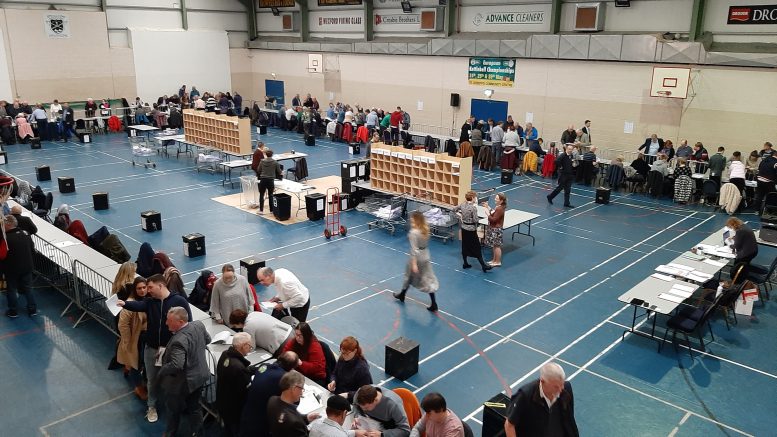
Voters in Wexford had an opportunity to vote in a By-election for the first time since 1945. That by-election was caused by the death of Richard Corish and was won by his son Brendan Corish, who later went on to spend 17 years as leader of the Labour Party, and 4 years as Tanaiste. During his time as Tanaiste, he also served as Minister for Health and Minister for Social Welfare.
Will the political career of our most recent by-election winner, Malcolm Byrne, reach similarly high levels? Certainly, the potential is there for him to do so. As an articulate, ambitious and hardworking county Councillor, well regarded within his own party Mr Byrne has many of the attributes needed to make an impact at the very top of political life in Ireland as a TD. I offer congratulations to Malcolm on his victory, which in the end proved to be by a comfortable margin.
A vote share for Malcolm of 31.2% is higher than the vote share of the 3 Fianna Fail candidates combined at the 2016 election, where Byrne himself polled at 8.5% of the vote and finished in 7th place. He has clearly built on this performance and the results of the by-election are evidence of this.
In second place was George Lawlor, who made it to the final count after leapfrogging Verona Murphy, following the transfers from Johnny Mythen and Karin Dubsky. Lawlor’s first preference vote of 20% is significantly higher than the national polling figures for the Labour Party and is also significantly higher than the vote level Labour achieved in 2016 in Wexford. In fact, Lawlor almost polled as highly as the two Labour candidates (Brendan Howlin and Pat Cody) combined in 2011. Certainly, it appears as though the future of the Labour party in Wexford in is good hands.
In third place was Verona Murphy, who polled a very respectable 23.8% of first preference votes. In fact, this percentage was higher than the 3 Fine Gael candidates combined in 2016. Transfers were the Achilles heel for Fine Gael in Wexford on this occasion, which may suggest that Ms Murphy polarised voters. Despite the somewhat controversial campaign, it appears as though Murphy can take plenty of positives from this by-election result.
In fourth place was Johnny Mythen, who polled at 10.3%. This was perhaps a ‘testing the waters’ mission for both Johnny and Sinn Fein in Wexford, following on from the poor results in the local elections where Mythen lost his seat as a county councillor. A vote share of 10.3% is slightly higher than the 10.1% Mythen received when he got within 53 votes of defeating Paul Kehoe in 2016.
In fifth place was the Green Party candidate and newcomer to the political arena, Karin Dubsky, who polled at 6.2%, which in fact is a higher percentage than all previous Green Party Wexford candidates combined. The problem with the Green’s in Wexford is that no candidate has run more than once which doesn’t allow them the opportunity to develop support, nor did they run any candidates in the local elections back in May. This may have been an opportunity for Ms.Dubsky to raise awareness of herself.
In sixth place was Jim Codd, representing the newly formed party of Aontu. Codd was one of the first people ever elected for this party, and his outing in the by-election was Aontu’s first attempt in a Dail election. We spoke to Aontu leader Peadar Toibin who was very pleased with Codd’s performance, which saw him get a very respectable 5.2% of the first preference vote. Certainly, something to work with going forward.
In seventh place was Cinnamon Blackmore of People Before Profit, who polled at 1.6% of the vote. Again, similar to the Green Party, PBP haven’t had any candidate run more than once in a Dail Election in Wexford. Familiarity is an important thing, and by constantly changing candidates the smaller parties will find it difficult to make an impact. When Richard Boyd Barrett first ran in a Dail election he also received 1.6% but 9 years later he was elected with 10.9% of the vote. Sometimes it can be a long process. A very passionate, caring and hardworking candidate, Blackmore was perhaps a victim of her parties low levels of support nationally.
In eight place was Melissa O’Neill of the Irish Freedom Party. Another new party on the political scene, O’Neill is the first-ever candidate to stand in an election for the IFP. From Limerick, O’Neill is a former Sinn Fein, Kilkenny County Councillor who currently lives in Waterford. Having polled 1.2% of first preference votes, O’Neill perhaps needs to reflect on how difficult the task is with no home support and local ‘core vote’. As far as we know, she intends to stand in the general election in Co.Wexford, and was using the by-election as a way of helping to boost her profile. Perhaps standing in Waterford may be more likely to reap a higher number of votes.
In ninth place was the only independent in the race, Charlie Keddy, from Kilcoole in Co.Wicklow. Keddy was standing as a Pro-Life candidate in this election. He described himself as a single-issue candidate. Interestingly, Keddy stood as a candidate in all 4 by-elections last Friday and his best result was the 130 votes he achieved in Wexford.
One thing which must be taken into account when comparing the percentage vote figures from the by-election to the 2016 general election is that in 2016, Independent candidates Mick Wallace, Ger Carthy, John Dwyer, Caroline Foxe and Emmet Moloney, polled 19.3% of the vote between them. Their absence from this race would suggest that the main candidates in the by-election should have polled 3/4% points higher than their equivalent 2016 results.
Looking ahead to the General election, it appears as though Wexford is going to be a very competitive constituency.
Declared candidates so far include:
Michael Darcy, Paul Kehoe and Verona Murphy (Fine Gael)
James Browne, Malcolm Byrne, Michael Sheehan and Lisa McDonald (Fianna Fail)
Brendan Howlin (Labour Party)
Johnny Mythen (Sinn Fein)
Jim Codd (Aontu)
Karin Dubsky (Green Party)
Cinnamon Blackmore (PBP)
Melissa O’Neill (Irish Freedom Party)
Ger O’Donoghue (Renua)
Other potential candidates include independents Ger Carthy, John Dwyer, Pat Barden, while possibly the key unknown in the race is who will Mick Wallace run under the Independents 4 change banner?
Other pressing questions are:
Will Fine Gael stick with Verona Murphy, or will she run as an independent?
Will Fianna Fail stick to their 4 candidate strategy or seek to reduce that number?
Will the Labour party be tempted to run both George Lawlor and Brendan Howlin?
Will Mick Wallace have a candidate, and if so, will they be high profile enough to stand a great chance of winning a seat?
Be the first to comment on "By-election 2019- what did we learn?"