
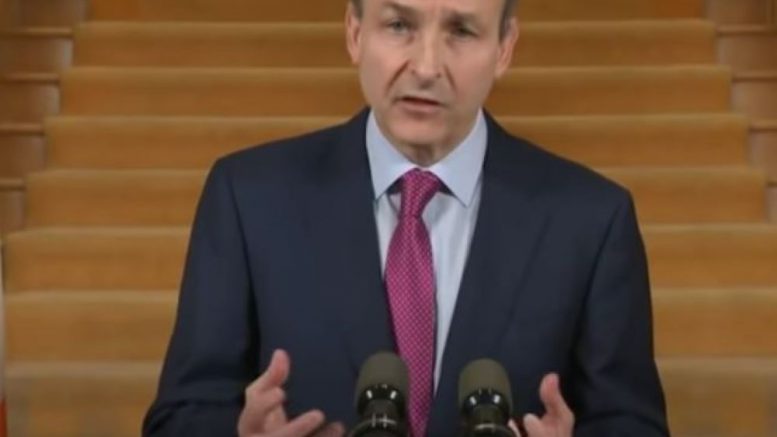
On February 23rd, Taoiseach Micheál Martin announced to the nation that the level 5 restrictions would be extended until April 5th. During that speech he also gave vital information regarding vaccination numbers, which gave hope to many people throughout the country.
He stated the following:
“By the end of March, we will have administered 1.25million doses. Then, depending on vaccines arriving as scheduled, we will administer, on average, more than 1 million doses per month during April, May and June.”
It would be reasonable to believe from this statement that the number of doses required to meet the target of 1.25 million doses by the end of March was secure. An Taoiseach did not give any conditions to this target. It was only the targets for April, May and June that were subject to conditions.
In that speech on February 23rd, the Government essentially made a deal with the Irish people.
Our part of the deal was to continue living in open prison conditions for 6 more weeks and the government’s part of the deal was to have 1.25 million vaccine doses administered by the end of March.
Let’s look at whether the government have kept up their side of the deal.
On February 23rd when An Taoiseach made his speech, there had already been a total of 373,280 doses administered. To meet the government’s target of 1.25 million doses, at least 876,720 doses would have to be administered in the 36 days between February 24th and March 31st, an average of 24,353 doses per day.
The latest figures available show vaccination numbers until March 18th. Data from the HSE’s IIS dashboard shows that up to and including March 18th, a total of 654,251 vaccine doses had been administered.
Hence, since the day of that speech, we have administered 280,971 doses up to and including March 18th. This is an average of 12,216 doses per day. (Not even our highest daily vaccine number has reached the planned average)
At the planned rate outlined on February 23rd, we should have reached the March 18th vaccine numbers by March 6th. In other words, 23 days into the plan we were already 12 days behind schedule.
Instead of averaging 24,353 doses per day, we have averaged only 12,216 doses per day, half of what was promised.
No doubt some people sympathetic to the plight of the government will point to the suspension of the AstraZeneca (AZ) vaccine as an unforeseen factor to mitigate against the delays in the rollout.
This argument can be contested:
- The AZ vaccine was only suspended last Sunday, after we had already fallen significantly behind schedule.
- Before the AZ vaccine was suspended, we averaged only 13,480 doses per day from Feb 24th to March 13th.
- The decision to suspend AZ went against the European Medicines Agency (EMA).
The government have constantly said that we must wait for approval from the EMA before we can start using any vaccines in Ireland, yet when it came to suspending the use of a vaccine, suddenly our government were able to do that without the EMA.
Some of the daily vaccine figures make for painful reading too. Last Sunday, March 14th, a grand total of 303 people were vaccinated in the entire country. That is not a typo, three hundred and three.
At this stage, I can feel some people ready to point out that March 14th was the same day the AZ vaccine was suspended, therefore understandable that so few vaccines were administered. But, let us look at the figures for other Sundays.
Sunday March 14th – 303
Sunday March 7th – 1,376
Sunday February 28th – 2,463
Sunday February 21st – 1,915
Sunday February 14th – 2,710
Sunday February 7th – 1,510
It appears the HSE are operating in 6 day a week mode, with Sundays’ being an afterthought. Is our vaccination programme so poorly staffed that we do not have enough people available on a Sunday? I cannot think of any reason given the current circumstances why the vaccine programme should slow to a crawl on a Sunday. Even if doses are limited we should still be trying to get them into peoples’ arms as quickly as possible.
For context, on the 20th of March in the UK 873,784 doses were administered. Adjusting for population, that is the equivalent of doing 65,207 doses in Ireland in a day.
The whole government response since October could be described in one word. Lethargic.
Lethargic about preparing for vaccinations, lethargic on vaccine rollout, lethargic on securing vaccine supplies, lethargic on coming up with a plan to ease restrictions, lethargic on recruiting volunteer vaccinators so frontline healthcare staff can return to other duties. It seems that the lethargic approach is set to continue on April 5th with a further extension of draconian restrictions.
Furthermore, the rush to demonise and criticise anti-lockdown protesters for daring to challenge all of this, is unfair. It is an attempt to deflect from the failings of the government to keep up their side of the bargain.
Members of the government parties, NPHET, HSE bosses, some in the national media, and many others who haven’t been financially impacted by the restrictions have labelled these people as reckless extremists.
Are they extremists for wanting their lives back, for wanting their businesses re-opened, for wanting to be allowed socialise, for wanting themselves or their children to be able to play sports, for wanting to be able to see their families, for wanting their jobs back, for wanting to go to Mass, for wanting to be able to pay their mortgage?
That is not extremism and it should not be labelled as such. I have never been at a protest or taken part in one, it’s not really my thing, but perhaps it’s time for us to think about whether we have allowed the government too much of a free reign over the last year, without enough of a challenge.
Rather than describing anti-lockdown protestors as extremists, let’s examine the extreme measures brought in by our government:
- Ireland’s lockdown has been extreme compared to other countries.
- It is the longest and most restrictive
- Making it illegal to travel beyond 5km of home
- Making it illegal to have visitors in your home
- Making it illegal to visit family members or friends
- Making it illegal to go clothes shopping
- Making it illegal to go to Mass
- Making it illegal to leave the country
- Making it illegal not to wear a piece of cloth on your face in a shop
- Making it illegal to play sports
- Putting almost 500,000 people out of work.
These extreme measures have been the reality for most of the last 12 months. So remind me, who are the extremists again?
There has also been a total failure of Government to acknowledge and communicate the reality that this virus will continue to be with us and will continue to make vulnerable people sick even after most have been vaccinated.
The vaccination programme should see the death rate reduce dramatically because most Covid deaths occur in older people, and they should be all vaccinated soon (hopefully!!), but this does not mean that no one will ever die from Covid again.
The flu vaccine available every year does not prevent all flu deaths or flu cases, nor will the Covid vaccine prevent all Covid deaths or Covid cases. That is a reality we all have to accept, otherwise there will continue to be hysteria and panic every time cases rise slightly.
The day will come when every single Covid restriction will be lifted, masks gone, social distancing gone, society re-opened and what a great day that will be. But judging by the government’s modus operandi for the past few months, this will depend on the speed of our vaccine rollout.
Based on the average figure for doses per day (12,216) since February 23rd, we will have everyone dosed twice by the 15th of May, 2023. Of course supply may increase, and single dose vaccines will also become available, so it is unlikely to take that long, but so far the Government are falling a long way behind their own schedule.
Who will pay the price? It won’t be members of the Government, who are set to receive another pay rise shortly, (and if unelected will retire on nice pensions), nor will it be the HSE boss Paul Reid who earns €420,000 per year plus expenses, nor will it be any of the 678 non-medical HSE staff who earn over €100,000 per year, nor will it be the members of NPHET who all earn between €104,000 and €187,000 per year.
They are the people making these decisions which are placing the financial burden back on everyone else. It’s not unreasonable to expect them to be doing a better job.
Perhaps if we paid those in charge a 50cent bonus for every dose administered, we might see a bit more urgency. After all, it’s only money.
Be the first to comment on "Government Falling Way Short of Vaccination Targets"